

|
|
|
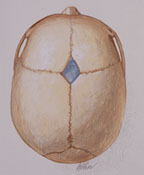 |
In order to understand craniosynostosis, it is helpful to know a little bit about the normal growth of the skull. The skull is not made up of one single bone, but instead is made up of different bones. The junctions where these bones meet are called sutures. We know that sutures are very important in growing children. The skull does not grow on its own; instead, it only gets larger because the brain is growing and putting pressure on the skull to get larger. So, when the brain is not growing, the skull does not get larger. In the first few years of life, the brain grows very quickly. As the brain grows, it stretches the skull bones apart, with the sutures acting like expansion joints. It is believed that this stretching of the sutures sends a signals to the skull bones (and to the covering of the brain, or “dura”) indicating the need for the skull to grow bigger (actually, the growth of the skull is slightly more complicated than this, and a simplified version is being presented here). If one of these sutures has fused shut, the skull cannot expand in this area of the skull sufficient to accommodate the growing brain, so the brain must push the other non-fused sutures further apart, in order to get enough room for the brain. This combination of factors (poor growth by the fused suture, and compensatory growth by the remaining open sutures) produces an abnormal skull shape, which then begins to become obvious to parents and pediatricians. |
Other common features of all
single sutural synostoses:
Fusion of the Suture
| Problems
Caused by Sutural Fusion
<<more about
single suture synostoses